Paediatric Ophthalmology and Strabismus

Paediatric Ophthalmology and Strabismus

Indira Gandhi Eye Hospital and Research Centre have well-equipped modern Paediatric Ophthalmology and Strabismus Clinics which offer a wide range of treatments for eye problems in children. Treatment of strabismus (crossed eyes) in adults is also provided. A team of experienced consultants handle treatment of all kinds of eye disorders in children. Till date, we have treated over 150,000 children for eye problems and operated around 16,000 children for eye disorders.
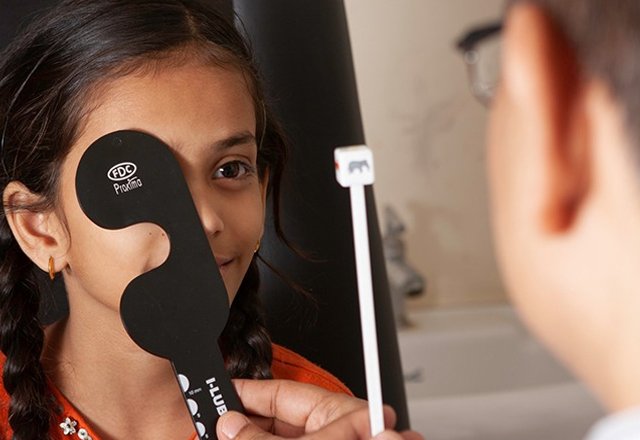
Technical set up

Treatments available

The department offers to the efficient diagnosis and management of a wide range of diseases

Procedures or surgeries

Cataract Surgery with Foldable Intra Ocular Lens Implantation: Cataract surgery in children is performed under General Anesthesia. Cataract extraction and foldable IOL implantation is performed through 2.8 mm incision. In younger children Posterior Continuous Curvilinear Capsulorhexis (PCCC) and Anterior Vitrectomy is performed to prevent posterior capsule opacification.
Congenital Glaucoma: Examination under Anesthesia is performed to make a diagnosis and combined trabeculotomy and trabeculectomy are performed to control intra-ocular pressure.
Congenital Nasolacrimal Duct Obstruction: Congenital blockage of Nasolacrimal duct who fails to improve with lacrimal sac massage are manged with probing of Nasolacrimal Duct with or without intubation
Concomitant Strabismus (Crossed eyes): Concomitant Strabismus are manged by eye muscle surgery.
Paralytic Strabismus following Nerve palsies: Paralytic Strabismus are manged by eye muscle surgery and transposition of eye muscles.
Nystagmus: Nystagmus is involuntary rhythmic movements of the eyes and are usually associated with abnormal head posture. They are managed by eye muscle surgeries.
Eye injuries: Conjunctival tear, corneal tear and traumatic cataract and traumatic glaucoma are managed by different procedure.

Frequently Asked Questions

What is the most common cause of congenital cataract?

The majority of bilateral congenital or infantile cataracts have no identifiable cause. Genetic mutation and familial transmission are the most common cause.

Surgical removal of cataract with or without IOL implantation is the only treatment of congenital cataracts.

Surgery should be performed between four to eight weeks of age

It’s a type of glaucoma in which high fluid pressure in eye damages the optic nerve. It affects children between birth and three years of age.

You may notice that your baby closes her/his eyelids, seems painfully sensitive to light and tears up a lot. Your child may also have large eyes (cornea) and cloudy cornea.

Surgery is the only treatment of Primary Congenital Glaucoma.

Strabismus (crossed eyes) is when your eyes are not lined up properly and they point in different directions.

Cataract surgery is a day care procedure, so you go home shortly after the surgery. You’ll need someone to come with you who can drive you home.
Here’s what to expect during the surgery:
Numbing medication: Your provider numbs the eye with drops or an injection. You may also get medication to help you relax. You will be awake during the surgery and see light and movement. But you won’t see what the ophthalmologist is doing to your eye. The surgery won’t hurt.
Cataract removal: Your provider uses a special microscope to see your eye. He/she creates tiny incisions to reach the lens. Then as ultrasound waves are used to break up the lens and remove it. Finally, the new lens is placed.
Recovery: You won’t need stitches. The tiny incisions close by themselves. Your provider will tape a shield (like an eye patch) over your eye to protect it.

Treatment may include glasses, patching, eye exercises and/or surgery.

IGEHRC, Gurugram

Sector 62, Gurugram122002, Haryana

0124-271-0271 | +91-966-762-0071

Mailus@igehrc.org

This will close in 20 seconds

Scroll to Top