Oculoplasty and Orbit

Oculoplasty and Orbit

The sub-speciality of Ophthalmic plastic surgery or Oculoplasty focuses on the functional and cosmetic deformities of the eye and structures around the eye arising due to disease or ageing. This niche branch in ophthalmology is fast evolving, with the introduction of minimally invasive, scarless procedures, into a beautiful amalgamation of science and art to meet patient’s expectations of quick hassle-free solutions to their problem. Indira Gandhi Eye Hospital and Research Centre provides the entire range of services at affordable costs.
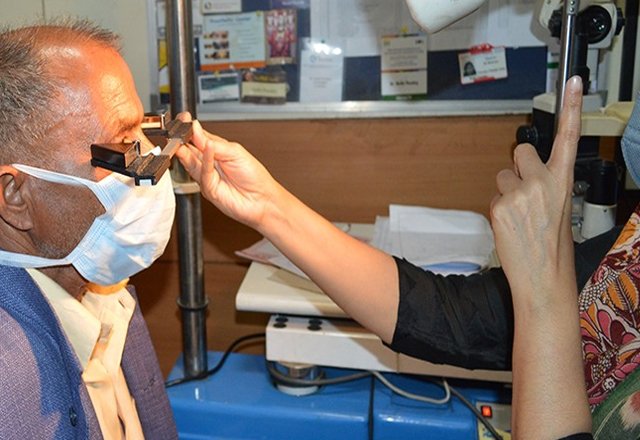
Technical set up

Procedures/surgeries

Lacrimal surgeries to relieve tear flow pathway blockage: Dacryocystorhinostomy/DCR - endoscopic procedure without skin incision; paediatric CNLDO – endoscopic guided probing and intubation facility for precise results; lid and canalicular tear repair with stent placement – repair of cut in the lid and tear duct with placement of temporary support using silicone stents; punctoplasty – dilation of blocked punctum
Ptosis (droopy eyelids) correction: A hidden scarless surgical approach is used to provide natural looking results (incision is place at back side of lid) – available at very few centres in India
Entropion, Ectropion and Trichiasis Correction (in turning of eyelids, out turning of eyelids and mid directed eyelashes) surgeries to correct mal positioned eyelid margin to relieve symptoms of itching, irritation of eyes and watering; radiofrequency ablation of misdirected eyelashes to provide permanent relief
Eye cancers – evidence-based management of all ocular cancers: eyelid cancers, e.g., squamous cell cancer, basal cell cancer, sebaceous cell cancer, etc.; intraocular cancers, e.g., retinoblastoma, uveal melanoma, etc.; orbital tumours, e.g., dermoid, schwannoma, haemangioma, etc.
The eyelid defect resulting from tumour removal is reconstructed with plastic surgery to give functional and cosmetic results. Removal of the eye for certain cancers is a life-saving measure. While the eye is removed safely to prevent any tumour dispersion, the empty space is reconstructed in the same sitting with an implant and a custom-made prosthesis is later fitted to provide a natural appearance
Anophthalmic socket surgery (shrunken eyes, deformed non-seeing eyes): surgery to fill the empty socket that either doesn’t have an eye or has a shrunken non-seeing eye due to trauma, disease, some birth defect, etc. This is followed by custom made ocular prosthesis to provide a natural appearance.
Maxillofacial surgery for Orbital fracture (fracture of bones around the eye): fracture of bones around the eye leads to functional and cosmetic problems. We offer comprehensive management of fracture repair and socket reconstruction with the latest technology of 3D printed implants to give the best results.
Scar management – disfiguring scars on eyelids: The presence of scars around the eyes can impact a person’s professional and personal life. We offer both surgical and non-surgical scar reduction procedures to smoothen both fresh and old scars.
Periocular and facial rejuvenation – management of wrinkles and lines on the face: botulinum toxin and filler injections for smoothening wrinkles and hollows to reverse aging changes on the face; therapeutic injections of botulinum toxin for involuntary and excessive facial movement
Thyroid eye disease – bulging eyes: medical and surgical management of thyroid-related eye problems such as protrusion, swelling and vision deterioration

Frequently Asked Questions

What is Oculoplasty?

It’s a sub branch of ophthalmology which deals with diseases of eyelids, eyebrows, orbit (space around the eye), lacrimal system (structures associated with tear drainage), eye malignancies (cancers) and cosmetic correction of the area around the eye.

The downtime varies for different surgeries. In a routine oculoplastic procedure, the patient is discharged the same day and can join desk jobs the next day and field jobs after a week’s rest. Certain complex procedures may require admission for one to two days. Normal activities are allowed after three to four days on an average.

Minor procedures can be performed the same day as the first OPD visit of the patient. However, most Oculoplasty surgeries are done after some tests on a planned date.

The operated eye is temporarily patched for few hours after which the patient can retain or remove patch as per her/his convenience. Some surgeries need prolonged patching for which the patient is informed well ahead of time so that she/he can make necessary arrangements.

IGEHRC, Gurugram

Sector 62, Gurugram122002, Haryana

0124-271-0271 | +91-966-762-0071

Mailus@igehrc.org

This will close in 20 seconds

Scroll to Top