Cataract Surgery

Best Cataract Treatment in India - IGEHRC

The Department of Cataract and General Ophthalmology offers a range of treatments that are the best in class in northern India. Renowned for providing the Best Cataract Treatment in India, the department has a team of experienced and acclaimed surgeons who are experts in advanced Cataract microsurgery procedures. It also serves as a Cataract surgery training centre where numerous ophthalmologists have been trained in various modalities of Cataract surgery since its inception
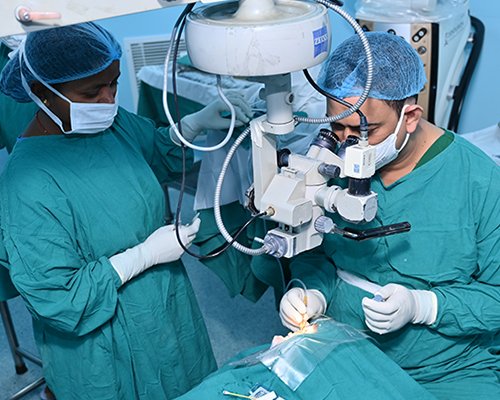
Technical set up

Treatment available

The department offers to the efficient diagnosis and management of a wide range of diseases:

Procedures or surgeries

The department has an array of surgeries to offer and provide most recent advances in the field of Cataract surgery which include:
Topical Microincision Cataract Surgery (MICS) with Foldable MULTIFOCAL / TRIFOCAL / TORIC AND TORIC MULTIFOCAL Intra Ocular Lens Implantation: Cataract surgery is performed without injection by the latest & most advanced Centurion Phacoemulsification vision system from a 2.2 mm incision and a foldable Multifocal/ Trifocal/ Toric / Toric Multifocal lens implanted .
Topical Microincision Cataract Surgery (MICS) with Foldable EDOF Intra Ocular Lens Implantation:Cataract surgery without injection by Centurion Phacoemulsification vision system from a 2.2 mm incision and a foldable Extended Depth Of Focus (EDOF) lens implanted
Traumatic Subluxated Cataracts:Cataract surgeries with inadequate Zonular support ; Cionni Ring, Segments or Capsular Tension Rings are implanted with Foldable IOLs. Wound exploration and reconstruction in cases of Penetrating trauma with cataract.
Management of Aphakia with Secondary IOLs: Scleral Tuck IOLs, Iris Fixated IOLs
Secondary Management of Surgical complications in cases referred from elsewhere: Our Surgical team has special expertise in the management of surgical complications of patients referred from outside
The department is equipped with microbiological and histopathological evaluations: of diseases of external eye diseases

Frequently Asked Questions

Are there different kinds of IOLs? Can an IOL eliminate my need for glasses?

IOLs are available with different focusing powers. Depending on the type of lens you select, you may or may not need glasses if you wore them before your cataract surgery.
Types of IOLs include:
Monofocal IOLs: These are precisely measured for close, medium- or long-range distance vision. Most people have them set for distance vision and then choose to wear reading glasses for close vision.
Extended Depth of Focus (EDOF): EDOF is a new IOL technology in the treatment of presbyopia. In contrast to multifocal (MF) IOLs, EDOF lenses create a single elongated focal point, rather than several foci, to enhance depth of focus.
Multifocal IOLs: These IOLs allow for both near and far focus at the same time.
Toric IOLs: These IOLs are designed to correct the refractive error in people with astigmatism.
Talk with your ophthalmologist about different IOL replacement options and what might be best suited for you.

Cataract surgery one of the safest routine procedures. Most senior surgeons have done performed the surgery thousands of times. However, like any other surgery, it comes with some risks:

If you have cataracts in both eyes, you’ll need two separate surgeries. Typically, you’ll have the procedures about two to four weeks apart. This way, the first eye has time to heal. Your vision can return in the first eye before the second surgery. It is a convention that both eyes are not operated simultaneously in adult cataract. But it can be operated may be the next day, after a week or three weeks.

You may need cataract surgery if cataracts are causing vision problems that interfere with your activities such as driving or reading.
Your provider also may need to remove a cataract to see the back of your eye and help manage other eye conditions, such as:
Age-related changes in the retina (the tissue at the back of the eye).
Diabetes-related retinopathy, an eye condition affecting people with diabetes.

When you first notice cataract symptoms, a new prescription for eyeglasses or contact lenses might help. But cataracts usually get worse over time. Eventually, you and your ophthalmologist may decide to do cataract surgery to help you see well enough to do all the things you want to do and need to do.
Cataracts are not an emergency and you can wait to have the surgery until it’s best for you. But with symptoms affecting your daily life routines, it is better to get the surgery sooner than later.

Cataracts and cataract surgery are very common in older adults. Cataract surgery is the most common surgical procedure performed in medicine.

Cataract surgery is painless as it is done under anaesthesia induced by either eye drops or a local injection. Some patients do experience some amount of discomfort during cataract surgery, but for most patients the procedure is painless. The eye surgeons take the utmost precautions to make sure that the pain is minimal. Patients are given oral medications before the procedure so that they do not experience any discomfort.

Cataract surgery is a day care procedure, so you go home shortly after the surgery. You’ll need someone to come with you who can drive you home.
Here’s what to expect during the surgery:
Numbing medication: Your provider numbs the eye with drops or an injection. You may also get medication to help you relax. You will be awake during the surgery and see light and movement. But you won’t see what the ophthalmologist is doing to your eye. The surgery won’t hurt.
Cataract removal: Your provider uses a special microscope to see your eye. He/she creates tiny incisions to reach the lens. Then as ultrasound waves are used to break up the lens and remove it. Finally, the new lens is placed.
Recovery: You won’t need stitches. The tiny incisions close by themselves. Your provider will tape a shield (like an eye patch) over your eye to protect it.

Cataract surgery is the best and the only treatment available for cataracts. The modern cataract surgery entails the use of cutting-edge advanced laser technology, imaging and phacoemulsification vision systems that have a high rate of success. During the early stages, your eye doctor may suggest a change in glasses to improve your vision.

The actual cataract removal only takes a few minutes. The entire procedure often takes less than 20 to 30 minutes but post-operative treatment can take up to an hour or so.

Most people go home within about 30 minutes after the surgery. You can typically remove the eye shield by the next day, although you may need to wear it while you sleep. You will need to use special eye drops for about four weeks after surgery.
It can take a few days to weeks for your vision to clear up. Other temporary side effects include:
Blurred or double vision
Gritty feeling in your eyes
Red or bloodshot eyes
Watery eyes

Cataract surgery is the only way to get rid of a cataract and sharpen your eyesight again. No other medicines or eye drops are proven to improve cataracts.
Cataract surgery has a very high success rate in improving people’s eyesight. After surgery, you can expect to:
See things clearer
Have less glare when you look at bright lights
Tell the difference between colours

You may notice that your vision becomes cloudy or blurry after your cataract surgery — even months or years after the procedure. Ophthalmologists call this posterior capsular opacification, or PCO, and it’s normal. It’s also called a secondary cataract.
PCO happens because a membrane called the posterior capsule becomes cloudy. The posterior capsule once held your eye’s lens and now holds the intraocular lens in place.
If your vision starts to blur again, you may need a posterior capsulotomy (laser procedure) to restore your vision. A laser makes an opening in the cloudy capsule. This procedure can give you clearer vision again.

Although it can take up to four to six weeks to fully recover from cataract surgery, most people will notice their vision begins to improve much sooner and, typically, there should little pain or discomfort during this period. During the days and weeks that follow surgery, follow your provider’s instructions to:
Use eye drops as directed
Use your eye shield, pad and eyeglasses
Read, watch TV and use the computer as usual
Use sunglasses when going outside
Resume your activities and routine
Don’t
Rub or press the eye
Get water or soap in the eye
Do strenuous activities
Use eye makeup for one week
Drive until your provider gives you the all-clear
Swim for two weeks after surgery
Fly without getting the all-clear from your provider

You'll need to wait until your eye has healed completely after cataract surgery, which usually happens about two to four weeks after surgery. You'll probably need a new prescription.

Cataract surgery is a safe, routine procedure. But like any surgery, it comes with risks, including:
Eye infection, bleeding or swelling
Retinal detachment, when the retina separates from the back of the eye
Damage to other parts of the eye
Ongoing eye pain
Blurred vision or vision loss
Visual disturbances, such as glare, halos and shadows
IOL becoming dislocated and moving out of place

No, cataract surgery can’t help restore vision due to problems from other eye conditions such as:
Diabetes-related retinopathy
Glaucoma
Macular degeneration

If you have cataracts in both eyes, you’ll need two separate surgeries. Typically, you’ll have the procedures about two to four weeks apart. This way, the first eye has time to heal. Your vision can return in the first eye before the second surgery.

IGEHRC, Ameth

HAL Korwa, Munshiganj, Amethi, District: Amethi-227412, Uttar Pradesh

+91-9161-850-560

Mailus@igehrc.org

This will close in 20 seconds

Scroll to Top